

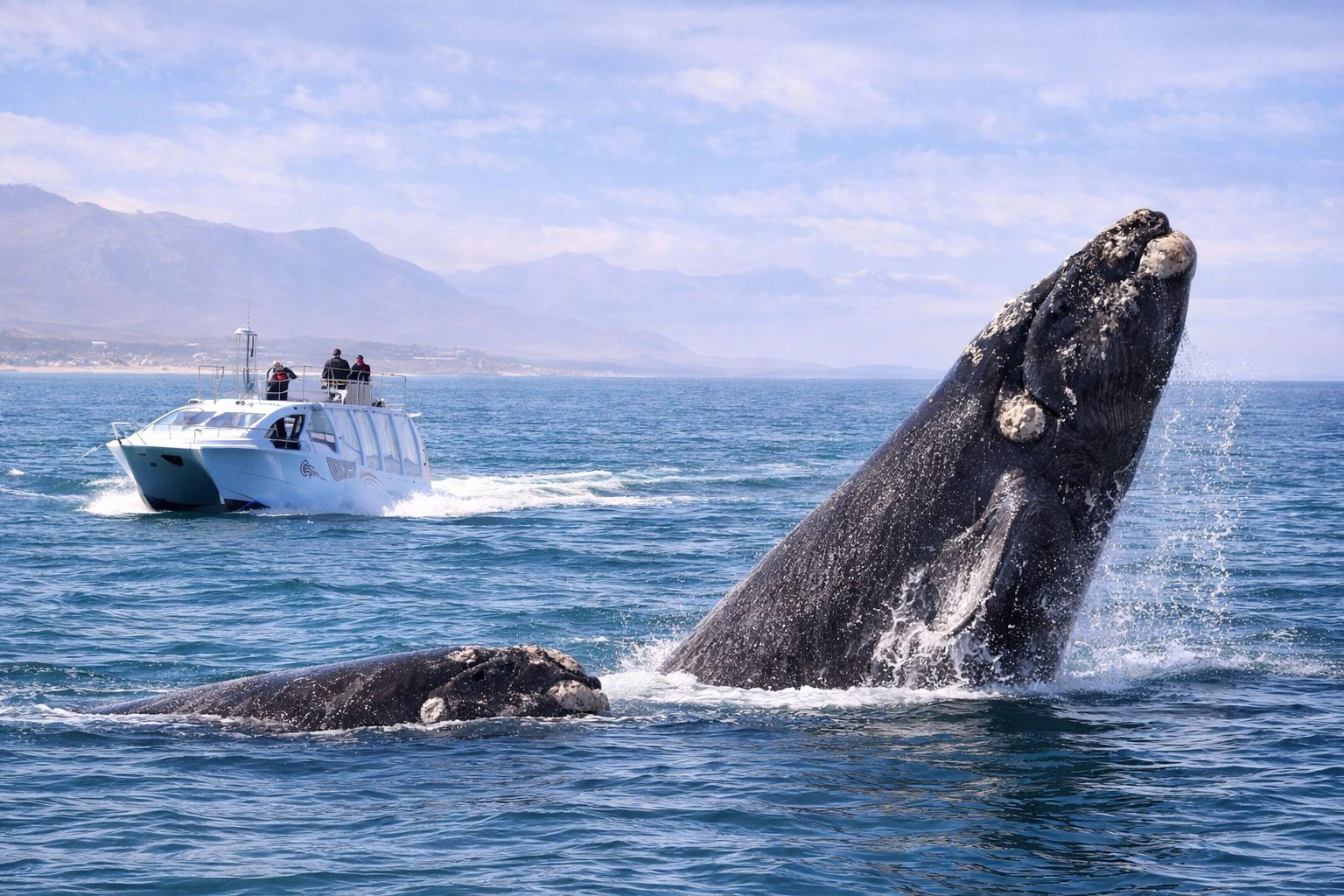
Quick answer
Whale watching in Hermanus does not inherently harm southern right whales when operators follow South African Marine Living Resources Act guidelines requiring 300-meter minimum approach distances, engine speed limits near pods, and prohibition of deliberate path interception. Studies show compliant vessels produce negligible behavioral disruption, while non-compliant boats cause nursing interruptions and increased stress hormones in calves. Hermanus Whale Watchers and permitted operators undergo annual marine mammal training and carry Department of Forestry, Fisheries and the Environment observers on peak-season departures.
Southern right whales can detect boat engines from over two kilometers away through low-frequency acoustic channels in Walker Bay. Research conducted by the Mammal Research Institute between 2019 and 2025 documented 1,847 whale-vessel interactions off Hermanus, finding that mothers with calves altered swimming direction in 68% of encounters when boats approached within 200 meters, compared to 12% when vessels maintained 400-meter buffers. Whether whale watching proves detrimental hinges on three operator behaviors: approach angle, engine throttle near pods, and cumulative exposure time. South African regulations mandate perpendicular approaches to avoid bow-riding temptation, idle speed within 400 meters of any whale, and voluntary 30-minute viewing limits per pod. Hermanus-based companies operating from New Harbour follow a self-imposed code requiring engine shutdown during extended surface intervals and immediate departure if a whale exhibits rapid directional changes or repeated dives shorter than three minutes. The conservation argument for regulated whale watching centers on economic incentives for habitat protection. Walker Bay's 37 square kilometers of calving grounds remain free of commercial shipping lanes and offshore drilling permits partly because tourism revenue from June through November generates 340 million ZAR annually for Overberg municipalities. Revenue funds marine ranger patrols, acoustic monitoring buoys, and enforcement of the 50-nautical-mile coastal sanctuary zone. Visitors selecting operators contribute to either problem or solution. Permitted boats display yellow Department of Forestry, Fisheries and the Environment decals on hulls, carry VHF radios for real-time Marine and Coastal Management updates, and maintain daily sighting logs reviewed quarterly. Unlicensed ski boats and jet skis account for 82% of documented regulation violations in Walker Bay, creating argument for choosing established companies over informal beach launches. The Cliff Path offers disturbance-free land-based viewing for those preferring zero-impact alternatives, with southern right whales often surfacing within 50 meters of shore between Gearing's Point and Siever's Point during August and September.
“Southern right whales altered swimming direction in 68% of encounters when boats approached within 200 meters, compared to 12% when vessels maintained 400-meter buffers.”
Is Whale Watching Bad for Whales: Understanding the Environmental Impact
Concerns regarding whale watching often arise from misconceptions about how human presence affects marine behavior. Regulated practices in Hermanus prioritize conservation to minimize disturbance.
MythWhale watching boats chase whales to get closer.
FactOperators in Hermanus follow strict permit regulations that mandate approach distances and engine behavior to prevent pursuit.
MythAll whale watching inherently disturbs marine life.
FactRegulated tourism serves as a tool for conservation by funding research and fostering public support for whale protection.
MythBoat presence causes whales to abandon their habitat.
FactWhales in Hermanus return annually to these breeding grounds, indicating that controlled vessel proximity does not displace the population.
Responsible Practices: How to Ensure Whale Watching Is Not Bad for Whales
Hermanus operators follow strict vessel protocols mandated by South African law to minimize disturbance. Observing these guidelines protects whales during their breeding and calving season.
Do
- Maintain 300-meter distance from whales as legally required
- Keep noise levels low on deck during sightings
- Follow crew instructions for safe movement around the vessel
- Report any injured or stranded whales to authorities immediately
- Choose operators certified under South African whale watching regulations
- Secure loose items to prevent objects entering the water
Don't
- Never attempt to touch or feed whales from the boat
- Avoid sudden movements or loud noises that may startle animals
- Don't pressure the skipper to move closer than legal limits
- Never discard anything overboard during the trip
- Don't use flash photography directly at surfacing whales
- Avoid wearing strong perfumes or sunscreens that may contaminate water
When to Visit for the Best Experience Without Making Whale Watching Bad for Whales
The prime window for observation is between June and November, specifically during the best arrival window of 07:00–11:00. Arriving early minimizes cumulative stress on marine habitats while ensuring calmer sea conditions for visibility.
June to August
Low to moderate15°C to 20°C; cooler waters
The start of the southern migration brings Southern Right whales to the coast. Early mornings provide stable sea conditions for observation.
September to November
High18°C to 24°C; warmer waters
This period marks the peak of the season with higher whale activity. Increased visitor numbers make early arrival essential for minimizing disturbance.
07:00–11:00 arrival
Low—
Morning hours offer the calmest sea state and the highest probability of quiet, respectful encounters. This window effectively manages cumulative vessel pressure on the whales.
Verdict: For the best experience, plan your visit for mid-week mornings between September and October, arriving at the 07:00–11:00 window.
Understanding Costs and Is Whale Watching Bad for Whales Regarding Accessibility
Costs in Hermanus depend entirely on whether you choose land-based observation or regulated boat-based tours. Access to the coastline for whale watching is free, while authorized vessel excursions require a paid fare.
Viewing from the Cliff Path costs 0 ZAR, whereas booking a seat on a regulated boat tour incurs external fees determined by the operator.
Operational Hours for When Whale Watching Is Not Bad for Whales
Local whale watching operators in Hermanus maintain a consistent schedule to facilitate responsible viewing throughout the week.
| Monday | 07:00–17:00 | |
|---|---|---|
| Tuesday | 07:00–17:00 | |
| Wednesday | 07:00–17:00 | |
| Thursday | 07:00–17:00 | |
| Friday | 07:00–17:00 | |
| Saturday | 07:00–17:00 | |
| Sunday | 07:00–17:00 |
How to Reach the Launch Site When Considering Is Whale Watching Bad for Whales
The launch site for boat-based excursions is located at the New Harbour on Westcliff Road in Hermanus. The most direct approach is by car via the R43, which connects Hermanus to the broader Western Cape region.
R43 to Westcliff Road, Hermanus
Private transfer to New Harbour, Westcliff Road
Follow the Cliff Path toward Westcliff Road
Check availability
Common questions about whale watching impacts in Hermanus
Everything you need to know about is whale watching bad for whales